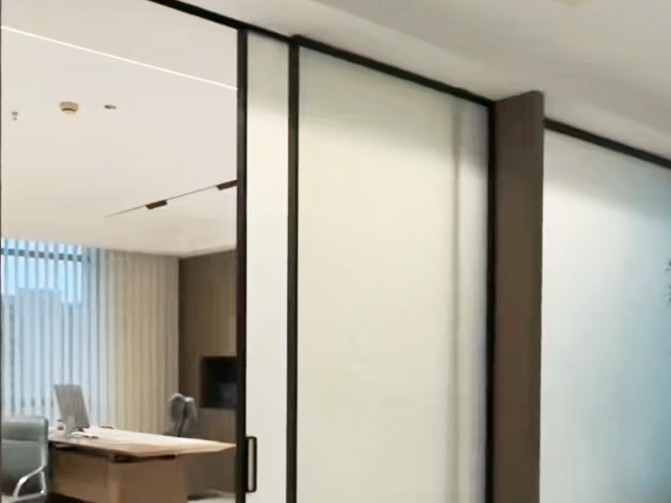


In the continuous iteration of automatic door technology, maglev automatic doors have gradually emerged in home, office, and other scenarios by innovating traditional drive logic. Unlike traditional automatic doors that rely on mechanical contact transmission, maglev automatic doors take magnetic field action as the core driving force, forming advantages in user experience, scenario adaptability, and emergency response, providing users with a space opening and closing solution more in line with daily needs.
I. Force Adaptability: Meeting Diverse Home Usage Needs
In home scenarios, the safety and convenience of use for the elderly and children are important considerations, and the force design of maglev automatic doors exactly meets this demand. Traditional automatic doors are driven by rotary motors, which need to drive belts to link with the door body during operation. To ensure operational stability, their output force usually exceeds 100N. However, relevant research data shows that children's tibia bearing capacity is limited, making it difficult to cope with external impact exceeding 10N. The force design of traditional automatic doors may cause inconvenience in home use.
Maglev automatic doors fundamentally optimize force control through non-contact maglev motors. Their operating force is always controlled below 10N. In actual tests, even a light balloon touching the door body can easily trigger the door to rebound, avoiding impacts on users due to excessive force. This gentle force design not only adapts to the usage habits of the elderly and children but also makes daily door opening and closing easier without extra effort, further enhancing the comfort of home use.
II. Noise Control: Creating a Quiet Space Environment
Whether in home or office scenarios, noise may affect the space usage experience, and the performance of maglev automatic doors in noise control has become one of their core advantages. Traditional automatic doors rely on mechanical transmission between rotary motors and belts, generating double noise during operation: on the one hand, the rotary motor itself emits mechanical noise when running; on the other hand, the friction between the motor and the belt, as well as the linkage between the belt and the door body, further intensifies noise. Such noise often exceeds the acceptable range of daily environments, making it difficult to meet scenarios requiring a quiet environment.
The non-contact drive structure of maglev automatic doors fundamentally reduces noise sources. Their core drive relies on the interaction of magnetic fields, with no mechanical contact friction during motor operation, thus eliminating the operating noise of traditional motors. The door body movement also avoids friction noise due to the absence of belt linkage. In actual operation, the noise of maglev automatic doors can be stably controlled below 40 decibels, a value close to the volume of soft indoor conversation in daily life, which hardly disturbs the environment. In quiet areas such as bedrooms and studies, or meeting rooms and office areas in workplaces, maglev automatic doors can maintain a quiet atmosphere, allowing users to avoid noise interference.
III. Power Outage Response: Ensuring Usage Continuity
Sudden power outages are potential situations in the use of automatic doors, and traditional automatic doors often fall into the dilemma of "unusable" at this time. The door body of traditional automatic doors is closely linked with belts and motors. After a power outage, the motor loses power, and the connection structure between the belt and the motor restricts the door body, resulting in great resistance or even inability to push the door manually. This brings obstacles to users' entry and exit, especially in scenarios requiring emergency passage.
The design of maglev automatic doors fully considers the usage needs after power outages. The non-contact maglev motor it adopts makes the magnetic field disappear after a power outage, and the linkage between the door body and the drive structure is lifted accordingly. At this time, the door body can be directly switched to manual mode without any additional resistance. When users push the door body, the hand feel is as smooth as a wheel sliding on a track, and the door can be easily opened without tools or excessive force. This design ensures that the door body can still be used normally after a power outage, guaranteeing the convenience and continuity of entry and exit, and avoiding usage interruption caused by power outages. Whether for daily home entry and exit or personnel passage in workplaces, normal order can be maintained in emergency situations.
IV. Energy Consumption Optimization: Achieving Rational Use of Electric Energy
In terms of energy consumption, maglev automatic doors realize the rational use of electric energy through refined power control logic. The motors of traditional automatic doors are usually in a continuous operation state. No matter which position the door body runs to, the motor remains powered on. Even when the door body does not need power drive, the motor still consumes electric energy, resulting in relatively high energy consumption costs in long-term use.
Maglev automatic doors integrate the characteristics of linear motors and adopt the "zonal power control" logic. Their stator is installed in the center, and the length of the permanent magnet track is slightly shorter than that of the movable door leaf. When the door body runs to the left area, the system only starts the left motor to provide thrust, and the right motor stops working automatically to avoid useless work caused by the right motor being powered on; when the door body runs to the right area, the left motor stops accordingly, and only the right motor works. Maglev automatic doors are equipped with independent feedback systems and drive devices for the two motors, which can real-time sense the door body position and dynamically adjust the motor working state. This design greatly reduces electric energy waste. Compared with traditional automatic doors, it can reduce energy consumption in long-term use, better meeting the energy-saving needs in daily use.
V. Scenario Adaptability: Covering Diverse Usage Needs
In addition to the above advantages, the design of maglev automatic doors also has strong scenario adaptability. In home scenarios, in addition to bedrooms and studies, it can also be adapted to kitchens, bathrooms, and other areas—in the kitchen, its low-noise characteristic can avoid affecting family rest, and no friction dust is generated, maintaining a clean kitchen environment; in the bathroom, the gentle force and convenient opening and closing method adapt to the usage habits of different groups of people.
In workplaces, maglev automatic doors can also exert their advantages. In meeting rooms, low-noise operation can ensure that meetings are not disturbed; the automatic doors in office areas can be opened without strong pushing, adapting to the high-frequency personnel passage needs; even in public areas such as corridors, the convenient door opening method after power outages can ensure the normal flow of personnel. In addition, the installation and use of maglev automatic doors do not require complex operations, adapting to the usage needs in different scenarios and further expanding their application range.
Overall, through the optimization of core dimensions such as force, noise, power outage response, and energy consumption, maglev automatic doors have formed significant advantages different from traditional automatic doors. They not only improve the comfort and convenience of daily use but also adapt to the needs of diverse scenarios, becoming a competitive choice in the automatic door field and bringing users a high-quality space opening and closing experience.
Note: The content above is sourced from the internet. If it infringes on your rights and interests, please contact us for removal.