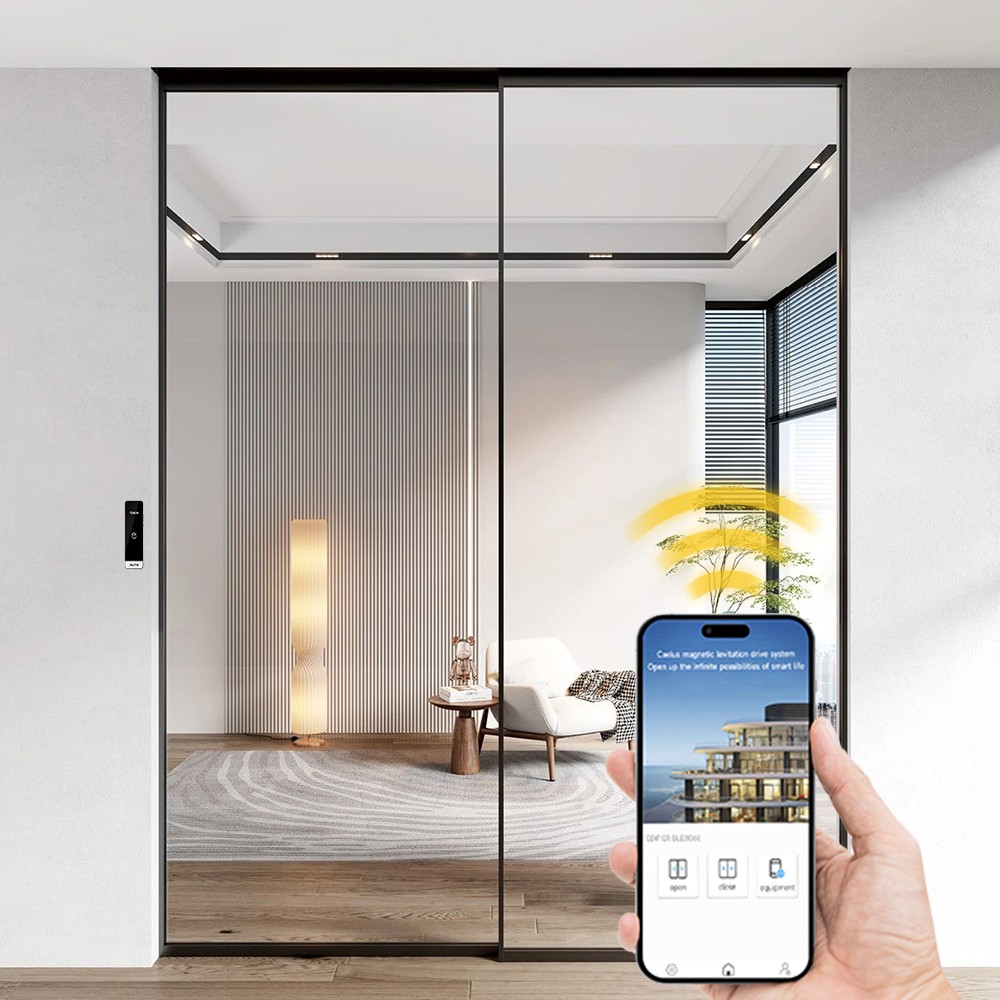


In shopping malls, hospitals, office buildings, and other venues, we often encounter doors that open and close automatically without manual pushing or pulling—these are automatic swing doors. As a common entrance and exit device in modern buildings, they have gradually integrated into people's daily lives thanks to their convenient user experience. So, what exactly is an automatic swing door? How does it work? And what are its characteristics? Below is a detailed explanation for you.
By definition, an automatic swing door is a swing door that can automatically complete opening and delayed closing actions triggered by sensing devices or control signals. It breaks the "push-pull required" operation mode of traditional manual swing doors, integrating mechanical transmission and intelligent control technology to achieve automated management of entrances and exits. Unlike automatic sliding doors, automatic swing doors open in the same way as traditional swing doors—rotating around hinges on one side of the door frame rather than sliding left and right. This opening method eliminates the need for horizontal space reserved for door sliding, offering greater flexibility in terms of entrance width and layout. It is suitable for scenarios with limited space or those seeking to retain the traditional door-opening form.
The operation of an automatic swing door relies on the collaboration of three core systems: "sensing - control - transmission," and the entire process can be divided into the following steps:
1. Sensing Trigger
The sensing device acts like the "eyes" of the automatic swing door, responsible for detecting whether there are people or objects needing to pass through. There are three common sensing methods:
Infrared Sensing: Emits and receives infrared rays to detect object movement within the sensing range. Once a movement signal is detected, it sends an "open door command" to the control system.
Microwave Sensing: Uses the reflection principle of microwave signals to perceive object movement, unaffected by light or temperature, making it suitable for complex environments.
Touch Sensing or Button Control: Requires manual touch of a panel or pressing a button to trigger the door-opening signal, commonly used in hospital wards, office building restrooms, and similar scenarios.
2. Control Processing
The control system serves as the "brain" of the automatic swing doors, composed of a single-chip microcomputer or control module. Upon receiving the signal from the sensing device, it sends specific instructions to the transmission system based on preset programs (such as opening speed and delayed closing time), such as "open the door at a specific speed" or "keep the door open for a few seconds after opening." Additionally, if the door encounters an obstacle while closing, the control system can detect resistance through sensors and immediately stop the closing action and reverse the door to open, avoiding accidents.
3. Transmission Execution
The transmission system is the "muscle" of the automatic swing door, responsible for converting electrical energy into mechanical power to drive the door's rotation. Currently, the mainstream transmission method is motor-driven, divided into two types:
Built-in Motor Type: Integrates the motor into the door hinge or door frame, connecting to the door via gears. When activated, it directly drives the door to rotate around the hinge, featuring a sleek appearance and suitable for scenarios with aesthetic requirements.
External Motor Type: Installs the motor on the top or side of the door frame, linking to the door through belts, chains, or connecting rods. It offers stable power output and easy maintenance, commonly used in high-traffic public areas.
4. Delayed Closing
After the door opens, the control system keeps it open for a preset delay time (usually 1-5 seconds, adjustable) to facilitate the passage of people or objects. Once the delay ends, the transmission system drives the door to close slowly, completing a full operational cycle.
Automatic swing doors can be classified into different types based on their driving method and opening direction:
By Driving Method:
DC Motor Drive: Adopts a DC motor, featuring low noise and low energy consumption. Suitable for small-scale scenarios such as homes and offices; the door can be manually pushed when there is a power outage.
AC Motor Drive: Uses an AC motor, offering strong power and high load capacity. Ideal for high-traffic areas with heavy doors, such as shopping malls, hospitals, and subway stations.
By Opening Direction:
Single-opening Type: Only one side of the door opens automatically, while the other side is fixed. Suitable for narrow entrances, such as residential entry doors and single office doors.
Double-opening Type: Both sides of the door open inward/outward simultaneously, or one side opens as the main door and the other as an auxiliary. It provides high traffic efficiency, making it suitable for wide public entrances like shopping mall main doors and hospital lobbies.
In terms of application scenarios, the convenience of automatic swing doors has led to their adoption in various fields:
Public Service Venues: In hospitals, nursing homes, and welfare institutions—where users are often the elderly, patients, or people with mobility impairments—automatic swing doors reduce access barriers. When paired with barrier-free ramps, they enhance the travel experience for these groups. In high-traffic areas such as shopping malls, supermarkets, and subway stations, they prevent congestion caused by queuing to push or pull doors.
Office and Commercial Spaces: Entrances, exits, and elevator lobbies of office buildings can be integrated with access control systems. Hotels, restaurants, and similar venues use them to reduce manual operations by staff, lowering labor costs.
Residential Scenarios: With the development of smart homes, automatic swing doors are also used for entry doors, kitchen doors, or balcony doors. For example, when returning home with hands full of items, infrared sensing can automatically open the door without the need to free up a hand to push or pull.
To ensure the stable operation of automatic swing doors during daily use and maintenance, here are some useful tips:
Do not forcefully push or pull the door while it is opening or closing, and do not place obstacles in its path to avoid damaging the transmission system.
Wipe the surface of infrared and microwave sensors with a dry cloth monthly to prevent dust from affecting sensing sensitivity.
Inspect transmission components such as motors, gears, and hinges quarterly for looseness or abnormal noise. Contact maintenance personnel promptly if any issues are found.
During a power outage, most automatic swing doors can be manually pushed (some require unlocking the manual device), but avoid excessive force to prevent damage to the door or hinges.
Integrating intelligent control and mechanical transmission technology, automatic swing doors. simplify daily operations through automation, making space entrance design more in line with people's usage needs. With technological upgrades, they may integrate more practical functions in the future, bringing greater convenience to life.
Note: The content above is sourced from the internet. If it infringes on your rights and interests, please contact us for removal.