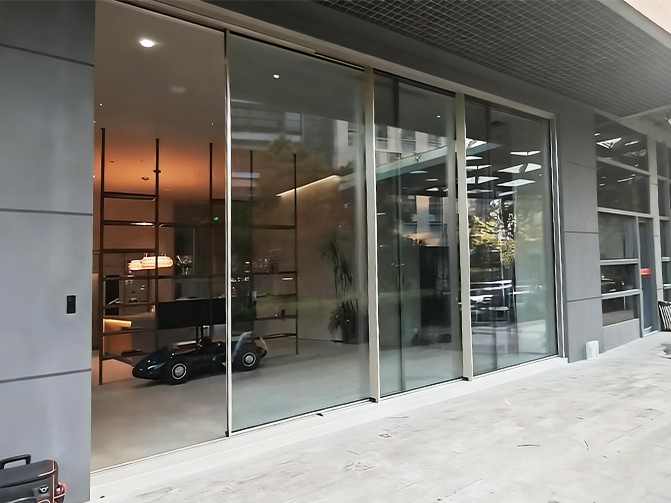


In the access design of modern buildings, automatic swing doors have become a preferred choice for an increasing number of venues due to their opening and closing method that aligns with traditional habits and flexible installation characteristics. Eliminating the need for manual pushing or pulling, they rely on sensing and electromechanical systems to complete opening and closing operations. While retaining the spatial advantages of swing doors, they integrate the convenience of automation, playing an indispensable role in multiple fields such as healthcare, commerce, office spaces, and residential buildings, and providing tailored access solutions for different scenarios.
Hospitals are a typical application scenario for automatic swing doors, as their requirements for convenient and hygienic access are highly consistent with the characteristics of automatic swing doors. At the entrances of various departments in outpatient buildings, patients often hold medical records or inspection reports, and some patients with mobility impairments require assistance from family members, making manual door opening extremely inconvenient. Automatic swing doors capture human body signals through sensing devices, and the door leaves open promptly, allowing patients to focus on moving forward and the medical process without being distracted by opening doors. In the ward corridors and elevator lobbies of inpatient departments, medical staff frequently shuttle with treatment carts, infusion stands, or wheelchairs. The advantage of the bidirectional opening function of automatic swing doors can provide sufficient access space for various medical equipment, avoiding delays in medical work due to door obstructions. More importantly, as hygiene-sensitive areas, hospitals benefit from automatic swing doors reducing the frequency of contact between personnel and door surfaces, thereby lowering the risk of cross-infection—a feature particularly crucial in consulting rooms, laboratories, and other areas.
Automatic swing doors are also increasingly common at the entrances of small shops and convenience stores. Customers in such venues are mostly passersby who stop temporarily, and many carry items in both hands while shopping, making traditional sliding doors prone to causing customers to face the dilemma of "difficulty opening doors." The sensor-activated opening mode of automatic swing doors can detect customers' intent to enter or exit, with door leaves opening gently and closing smoothly, creating a seamless access experience for customers and implicitly enhancing the service quality of the store. Meanwhile, the facade space of shops is usually limited. Automatic swing doors do not require track installation and do not occupy additional space in front of or behind the door, which is particularly practical for shops. During peak hours, the rapid response capability of automatic swing doors can prevent customer congestion at the entrance, ensuring smooth access channels, which not only improves the shopping experience but also indirectly attracts more potential customers for the store.
Office buildings and workplaces have requirements for orderly and comfortable access, and automatic swing doors demonstrate strong adaptability in such scenarios. At the lobby entrances of office buildings, where visitors and office staff flow frequently, the stable operation of automatic swing doors can enhance the professional atmosphere of the venue. After entering the office area, the selection of door bodies for spaces such as meeting rooms and reception rooms is particularly critical. During meetings, participants often carry laptops, documents, and other items. The automatic opening function of swing doors allows everyone to enter and exit in an orderly manner, avoiding interruptions to the meeting rhythm caused by manual door opening. As an important space for communicating with clients, reception rooms benefit from the silent operation of automatic swing doors, which maintains a quiet indoor environment and provides a suitable atmosphere for communication. In addition, some office areas are equipped with access control systems. Automatic swing doors can be linked with access control systems, controlling opening permissions through methods such as card swiping or fingerprint recognition, ensuring the privacy of the office area while not affecting the normal access of internal personnel.
The application of automatic swing doors in the residential sector is expanding from villas to unit doors of ordinary residential buildings. At the entrances of residential unit buildings, traditional unit doors are mostly manually operated sliding doors. When residents return home from work, they often carry briefcases, shopping bags, and other items, and need to free one hand to take out keys to open the door, resulting in a cumbersome process. After integrating with the community access control system, automatic swing doors can be activated by residents through card swiping, password input, or facial recognition, with the door body opening automatically, making the journey home more convenient. For families with elderly members and children, the convenience of automatic swing doors is even more important. The elderly move slowly, and children have limited strength, making manual opening and closing of unit doors inconvenient. Automatic swing doors solve this problem, providing guarantee for the daily travel of family members. Indoors in private residences, small automatic swing doors can also be installed in spaces such as studies and cloakrooms, which not only improves the convenience of life but also adds a modern touch to home design.
Environments such as cleanrooms and laboratories have clear standards for door tightness and operational stability, and automatic swing doors can meet the requirements of such scenarios through specialized design. Cleanrooms are used for producing precision electronic components, pharmaceutical products, etc., requiring maintenance of specific cleanliness and air pressure environments indoors. The tight closing of automatic swing doors can reduce the circulation between outdoor and indoor air, ensuring that the clean environment in the workshop is not disturbed by external factors. During operation, the stable closing characteristic of automatic swing doors avoids the problem of reduced cleanliness caused by incomplete door closure. Various experimental operations in laboratories have strict environmental requirements, and some laboratories involve the transportation of chemical reagents. The automatic opening function of swing doors allows researchers to focus on reagent transportation and experimental operations without being distracted by manual door opening, while their stable operation also provides support for the experimental environment.
From healthcare venues to commercial spaces, from office areas to residential environments, automatic swing doorsplay an important role in different scenarios by virtue of their flexible installation methods, convenient user experience, and diverse adaptability. Centered on users' access needs, they continuously adapt to the requirements of various venues through technological optimization, becoming an indispensable access facility in modern buildings. With the renewal of architectural design concepts and technological progress, the application scenarios of automatic swing doors will continue to expand, bringing convenient and comfortable access experiences to more people.
Note: The content above is sourced from the internet. If it infringes on your rights and interests, please contact us for removal.